
Summary
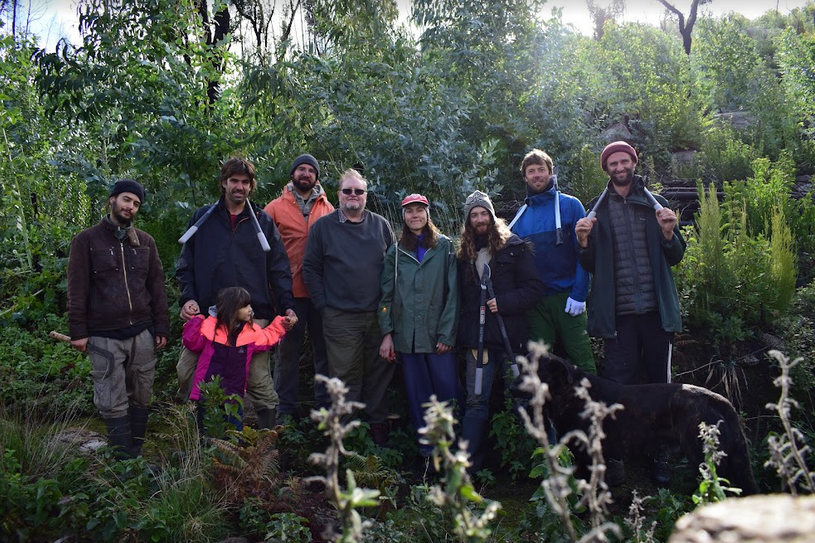
Reflorestablitz is a gathering of eco-conscious souls to regenerate land, an idea born at the “2nd Forest Gathering” organized by Reflorestar Portugal. From November 16 to 21, 12 brave volunteers came together to face the harsh winter conditions in Monchique and planted trees, built check dams and cut down eucalyptus. This was a follow-up event to the Ecosystem Regeneration Camp (November 11-15), a 5-day course on practical land regeneration techniques. It was a perfect combination: in the first week we learned the theory, in the second week we put it into practice on land badly degraded by forest fires. The land belonged to Vizinhos da Balsa, a collective of 7 families whose interconnected land shares a common Permaculture design for water and forest management in the Picota de Monchique region. In 2018 Monchique was consumed by flames and these 7 families lost everything. Despite this, the families stayed and began rebuilding. One of the priorities is to replace the high-density eucalyptus stands and their fire-prone ecology with a diverse woodland made up of oaks, chestnut trees, strawberry trees and alders, which can withstand fire and reduce its temperature and speed while increasing the area’s ecological integrity. Some of these trees were donated by Reflorestar Portugal through its campaign with Muki, a Portuguese sustainable footwear company. In this article we’ll share the strategy chosen to manage the eucalyptus monocultures, a recipe for seed pellets, and the importance of building small, low-tech solutions.
Managing eucalyptus monocultures
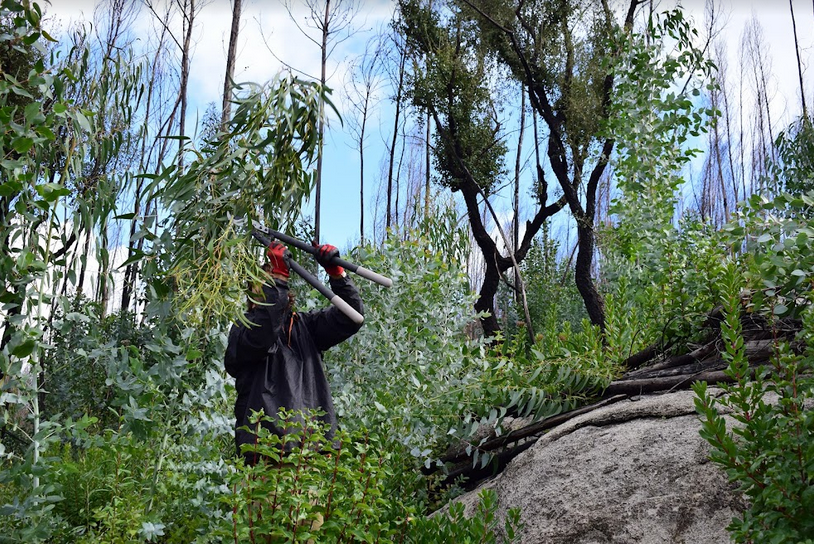
Eucalyptus (Eucalyptus globulus) has been demonized over the years. The truth is it’s a beautiful tree that’s incredibly resilient. It also has many uses: the shredded wood can be used as a carbon-rich material in compost piles, the leaves of young shoots are full of essential oil, and it’s good timber for building. The problem starts when we have a monoculture of this tree. Its allelopathic properties mean that almost no other plant grows beneath it. Large areas of eucalyptus monoculture are a fire risk due to their flammable essential oils and threaten nearby communities, such as Vizinhos da Balsa. The forest of Monchique needs management that allows it to become a balanced, rich ecosystem again, as it once was. This means most of the eucalyptus trees must be removed. This tree’s resilience makes removing it a considerable challenge. New shoots emerge from the burnt trunk twice a year, forming an octopus-like shape with tentacles reaching straight up to the sky.
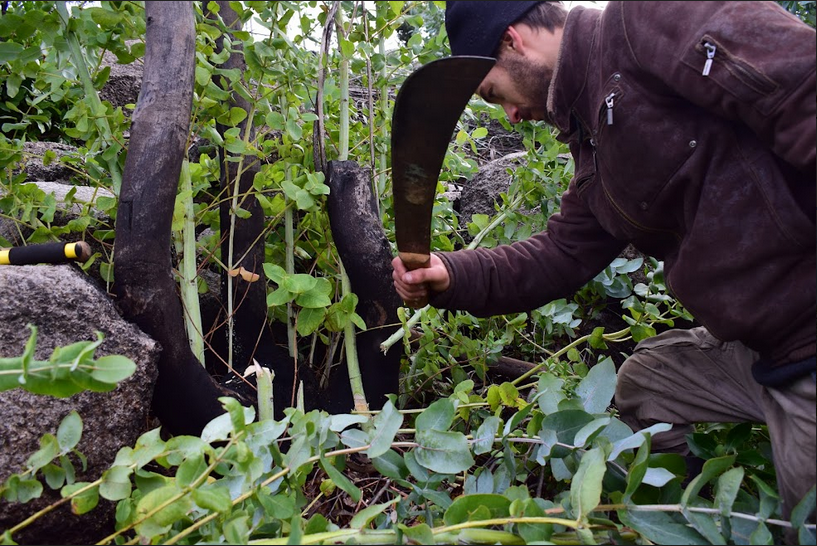
A management method was shared with us on the second day by Justin Roborg-Söndergaard, a GEOTA consultant in charge of a large-scale reforestation project in Monchique:
“The method or technique consists of cutting the main trunk about 1.5m from the ground (known as coppicing) and then removing the bark from the cut trunk down to ground level. The cut trunk can then be coppiced, that is, it will resprout from so-called ‘epicormic shoots’. These shoots produce sprouts which are then cut back, leaving only 1. This technique also requires removing the epicormic node from the removed sprouts, this action also impacts the stump. The remaining shoot is left until the next dry season, when it is then removed. The same technique is applied over a rotation of 2 to 3 cycles before the main stump succumbs or dies (this also depends on environmental factors such as soil and water). This technique is time-consuming and labor-intensive, but it is probably the most sustainable method possible, as opposed to stump extraction (an expensive and ecologically costly method), since it doesn’t involve the use of chemicals and has a low impact on root systems and therefore on soils. Furthermore, the shoots (or coppices) can be left to grow into small timber-producing trees. In this way, what was once a large eucalyptus plantation can be manually reduced to a small number of controlled coppices.”
The important aspect of this method is that new trees can be introduced interspersed among the eucalyptus stumps, for example, cork oaks. The existing soil conditions are favorable to introducing this new species, which can then be cultivated to replace the previously dominant eucalyptus. Restoring, or converting, eucalyptus plantations will take time. If done correctly, the result will be a low-impact recovery that supports the soil’s organic components and, therefore, other associated species such as fungi, a highly desirable resource, both as a food source and ecologically. It’s worth remembering that in every aspect of human intervention in natural systems, we depend entirely on conditions normally beyond our control, such as climate and how plants react to their new environments. We must also understand that “nature’s time” is not “human time,” so patience and sustained effort become important traits for anyone taking on the enormity of intentionally restoring degraded or damaged ecosystems. Furthermore, the path to degradation is not the same as the path to recovery. The path to recovery is unpredictable and comes with a number of uncertainties we need to work with — chiefly by making sure we record our actions and their results.
The rewards are many when we succeed at what Justin calls “a calm conversation with Nature.”
Seed Ball Recipe
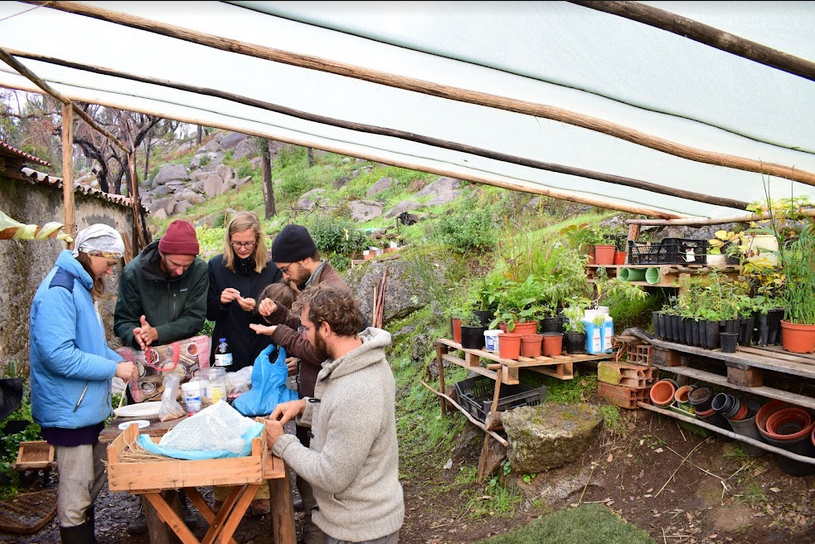
Inspired by the Regenerative Agriculture course taught by Carlos Simões and Catarina Joaquim a few weeks before this event at Vale da Lama, we decided to experiment with seed pellets. The idea is to create a protective shell around the seed using clay, while filling the center with all kinds of nutrients and inoculants that will help the plant grow. The result is a “compacted” seed that is protected from predation by birds and given an abundance of micronutrients. The seed mix was made up of 20 different native plants, including weeds, grasses, legumes and shrubs, collected by the landowner from areas less affected by the fire.
Ingredients:
- Worm tea (inoculant)
- Casuarina tea (rich in silica)
- Ash (rich in many minerals)
- Fungal inoculants (create symbiosis with plants)
- Clay (protective seal)
- Seed mix (mainly native shrub species)
- First, in a large bowl, add the seeds and the liquid ingredients (in our case: worm tea and casuarina tea). Make sure all the seeds are moist. Rub the seeds together if there’s too much liquid in the bowl.
- Then add all the dry ingredients except the clay and mix well by hand.
- Once the seeds are coated with the dry materials, add the clay to create a protective shell around the seeds. Add a bit more liquid ingredients if there isn’t enough moisture left for the clay to stick.
- Using your hands, roll the seeds into small balls.
This recipe is meant as inspiration. It’s a step above simply scattering seeds around, but it’s not an exact science. Use whatever ingredients you have on hand, the only “required” ingredient is clay. The best way to learn is to experiment and see what works best on your land.
Mini dams
The Picota de Monchique region is very steep, and after the fires one of the main problems is soil loss due to water erosion. A simple technique to mitigate this issue is to build small check dams along the terrain’s contours using whatever materials are found on site. It’s a very easy, low-cost solution to soil loss in mountainous regions. I first used this technique on a reforestation project in Velez-Blanco in 2017, on a steep mountain called La Muela (you can read all about it in another blog post here). The typical Mediterranean climate means rainfall is concentrated in a short period. Steep hills, like Picota and La Muela, are therefore more prone to soil loss.
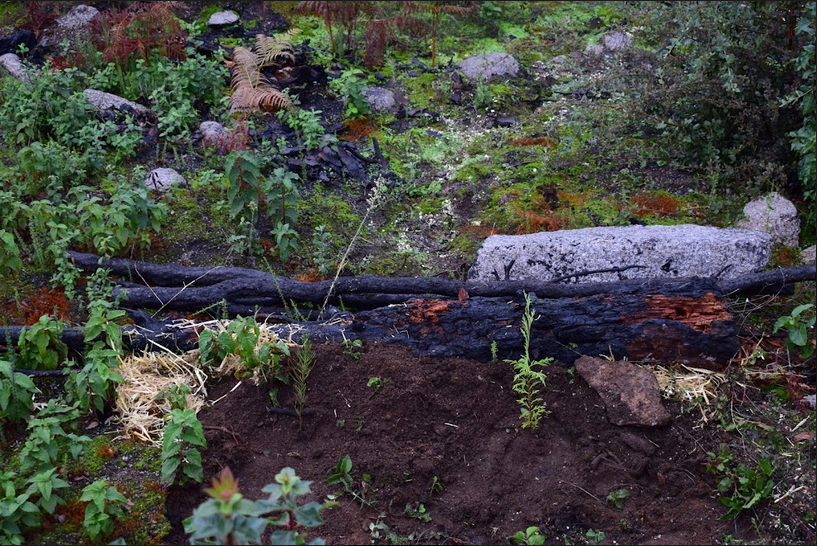
Starting from the top and working down, we used rocks and burnt wood to build dams at spots where the apparent water flow was strongest. We also placed a layer of straw beneath the rock and wood to further increase the dam’s capacity to retain soil and water.
These dams will slow the water down, allowing it to infiltrate the ground, as well as capturing any runoff soil. We also turned each dam into a small tree habitat, gathering soil and planting saplings on the sides of the dam (where the water flow is weaker), sowing acorns and seed balls, and finally covering them with hay.
Final Words
The combination of all these techniques results in a holistic regeneration effort that’s fun and exciting to implement. Only time will tell if all these ideas really work, but we all left with a great sense of accomplishment.
I would like to give special thanks to all the volunteers who joined this regenerative event. We faced the winter conditions of Monchique and got a lot of great work done. We’re all very proud to have contributed to regenerating this burned land. We left our mark on this forest and hope to see it grow and flourish. Spending our time on this kind of reforestation event fills our hearts with inspiration, enjoying nature and forging a truly deep connection with Gaia. I can’t imagine a more important task in our current times than regenerating degraded land. We built strong bonds with the land, the families of Balsa, and with each other. It was a great adventure, and I’m so happy such a resilient group of people came together. These special pioneers are: Klaus Gruber, Luis Falcão, Candida Shinn, Pedro Glória, Pauline, Anne Popma, Elias den Otter, Luís Picciochi, and Jeremy Lhoir. I hope to see you again at another edition of Reflorestablitz.